In the early days of document automation, optical character recognition (OCR) was a breakthrough. It allowed machines to ‘read’ printed text from scanned documents and turn it into editable, searchable data. But for many organizations, OCR alone quickly reached its limits. It struggled with handwritten forms and the vast variability of real-world documents.
This gap led to the emergence of intelligent character recognition in the early 2000s, as machine learning techniques made it possible to recognise handwritten and variable text at scale. It was a major step in the evolution from OCR to ICR, then to intelligent document processing (IDP)and now, agentic IDP.
In this article, we’ll unpack what ICR is, how it works, its value and limitations and how it paved the way for today’s more advanced IDP platforms, such as Affinda.
What is intelligent character recognition?
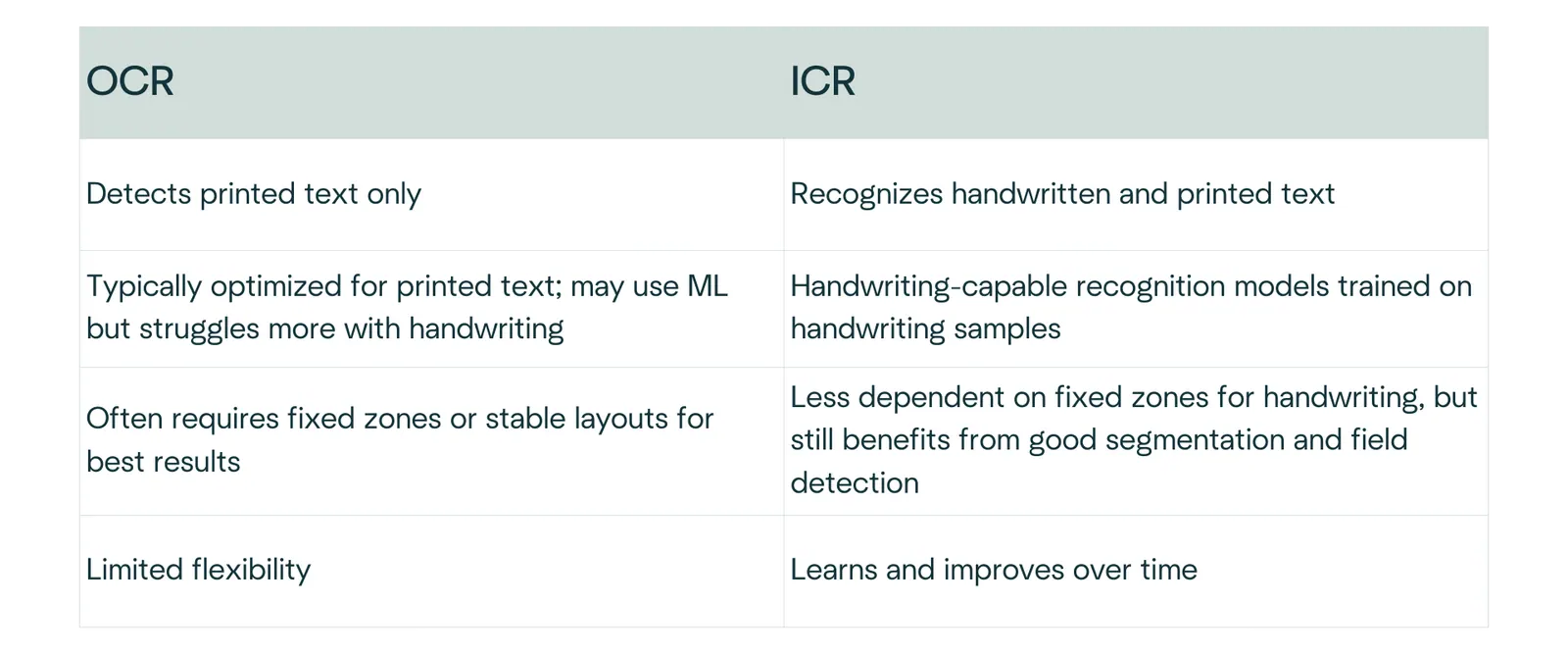
Intelligent character recognition (ICR) builds on traditional OCR, using machine learning to recognize and interpret handwritten text and variable writing styles. It’s capable of identifying cursive or printed handwriting and adapting to different pen pressures, angles and character shapes.
Unlike traditional OCR, which relies on predefined character templates, ICR models learn from examples. Over time, they improve their accuracy at recognizing new handwriting styles as text or document formats.
Key differences between OCR and ICR
Because intelligent character recognition software can interpret handwriting and variable layouts, it has many common use cases across industries, including:
- Lending and financial services – handwritten loan applications, income declaration forms, change-of-details requests, wet-signed credit agreements and guarantor forms
- Commercial insurance and claims – claim forms completed by brokers, adjuster notes, handwritten annotations on medical reports and loss descriptions
- Settlements and asset finance – settlement instructions, hand-completed direct debit mandates, authority forms and signed term sheets
- KYC, onboarding and compliance packs – account opening forms, beneficial ownership declarations, risk questionnaires and documents that mix typed fields with signatures and free-form comments
- Embedded workflows in lending and insurance platforms – broker-uploaded PDFs and scans that combine typed fields, ticks, handwriting and signatures inside loan origination or policy servicing systems
How ICR works (compared to OCR)
Intelligent character recognition software extends OCR by applying machine-learning models to recognize handwritten and variable text, rather than relying on fixed templates.
A typical ICR system combines:
- OCR engines to detect and isolate text regions in scanned images
- machine-learning models trained on labeled handwriting samples
- pattern and style recognition to account for variations in letter shape and writing styles
- confidence scoring to estimate the reliability of recognized characters or words
While OCR relies on hard-coded templates, ICR uses trained models to generalize across handwriting styles. However, this adaptability comes at a cost. Because handwriting varies widely across individuals and context, stand-alone ICR systems require large datasets, ongoing retraining and maintenance. This can quickly become challenging in enterprise environments.
What are the benefits and limitations of ICR?
ICR represented a step-up in data extraction technology. It made it possible to recognize handwritten text and digitize variable-format content at a greater scale than OCR alone, reducing manual data entry and improving accuracy. But its limitations became more visible as use cases grew more complex.
What are the benefits of ICR?
- Better recognition of handwritten and variable text as ‘text’ compared to OCR alone
- Reduced dependence on static, rule-based templates
- Improved tolerance for noisy scans and inconsistent handwriting styles
What are the limitations of ICR?
- Accuracy plateaus when handwriting or layouts vary significantly
- High training and maintenance overheads
- Difficulty adding new data fields, document types or languages without retraining
- Little understanding of document context and relationships between fields
In short, ICR improves character recognition, but it doesn’t understand a document’s intent, structure or relationships between data fields. ICR can help around signatures by extracting nearby handwritten names or detecting signature presence, but signature verification is typically a separate capability. That’s what led to the rise of intelligent document processing.
ICR’s role in the transition to modern IDP platforms
Intelligent character recognition software was the bridge between static OCR and the dynamic intelligence of IDP. While OCR focused on extracting characters from fixed layouts, ICR improved recognition of handwritten and variable text. IDP expanded the scope further, moving beyond character recognition to include document structure, context and relationships between data fields.
Instead of simply identifying letters, IDP systems can:
- recognize document types automatically – even when layouts and formats vary
- structure and extract data fields like totals, dates, names and reference numbers
- apply contextual reasoning and business rules (for example, to tell which amount is an invoice total and which is a tax total)
- integrate validation, exception handling and workflow routing
OCR made text extraction possible. ICR made it more flexible. Together, they laid the groundwork for document data extractionand modern IDP platforms that interpret documents as a whole.
From modern IDP to agentic IDP: the new standard
Agentic IDP introduces an even greater leap forward than popular modern IDP platforms available today. AI is used to dynamically coordinate document processing tasks, such as OCR, document classification, extraction and language models. They then verify outputs against the source document and improve over time through feedback, not retraining cycles. AI agents are then used to connect and send this data to action in your downstream business systems.
In agentic IDP, ICR is no longer a standalone solution but a foundational capability. It supports recognition of handwritten and variable text, while AI agents take the orchestrated classification, extraction, validation and routing through the full document automation workflow.
How agentic IDP surpasses ICR
- Understands context and relationships between fields, not just characters
- Produces structured, validated outputs from unstructured documents
- Adapts to new layouts and languages
- Applies grounding, validation and provenance checks for reliability
- Learns continuously through feedback and Model Memory
This marks a shift beyond earlier generations of IDP – from extracting data within predefined workflows to managing complexity across end-to-end document workflows.

Why ICR is still needed today: fueling the best agentic IDP solutions available
ICR remains an important component of a robust intelligent document processing solution. It enables the recognition of handwritten and highly variable text, supporting data extraction from documents that OCR alone struggles to handle. Without ICR, IDP systems would be limited in their ability to process handwritten documents at scale.
But for most enterprises, modern IDP or agentic IDPis the more strategic choice when:
- document volumes are high and manual processing doesn’t scale safely
- multiple languages or formats are in play and layouts change often
- accuracy requirements are consistently high and tolerance for error is low
- data relationships, validation and auditability are critical for operational confidence
- rapid onboarding and scalability are essential
For these organizations, an ICR platform alone won’t meet the flexibility, accuracy and scalability requirements it has, making it an outdated approach.
Download our complete guide to intelligent document processing
Get a practical, end-to-end overview of intelligent document processing, including how it works, where it’s used and what to look for in a modern intelligent document processing solution.
How Affinda exceeds traditional ICR capabilities
While some IDP vendors market their platforms as intelligent document processing solutions, they are actually OCR and ICR models stitched together. In contrast, Affinda Platform represents the next generation of intelligent document processing: an agentic IDP solution that automates entire document workflows, including classification, extraction, validation and integration.
Affinda’s benefits for business outcomes
- Faster document processing with reduced manual review
- Higher accuracy without repeated retraining cycles
- Scales to support growth without constant new resource pressure
- Workflows that run reliably in production, not just in demos
- Transparent, predictable pricing with measurable ROI
- Human oversight focused on exceptions, not every document
Affinda’s benefits for technical delivery
- Easy configuration and rapid onboarding
- Reliable API-first architecture
- Handles document variability and multilingual workflows
- Consistent outputs with built-in validation
- Human-in-the-loop review and exception handling
- Clear guardrails using retrieval-augmented generation (RAG) and fingerprinting
- Fast time to production with integration into existing systems
Affinda isn’t just intelligent character recognition software; it’s the modern successor that orchestrates the full document workflow, delivering clean, structured data to downstream systems.
ICR in context and the path forward with IDP
Intelligent character recognition was an important evolution in document processing automation, acting as the bridge from OCR to IDP and now agentic IDP. It marked the shift from simple scanning to adaptive learning, laying the groundwork for today’s intelligent document systems.
But as business needs evolved, so did the technology. Enterprises now require IDP platforms that handle real-world document variety, deliver decision-ready data and integrate seamlessly with downstream systems.
The future is agentic IDP – intelligent, production-ready and designed to improve continuously as documents, formats and workflows change. Explore the Affinda platform to learn more, or sign up for a free trial to see how your organization can move beyond ICR toward full document intelligence.