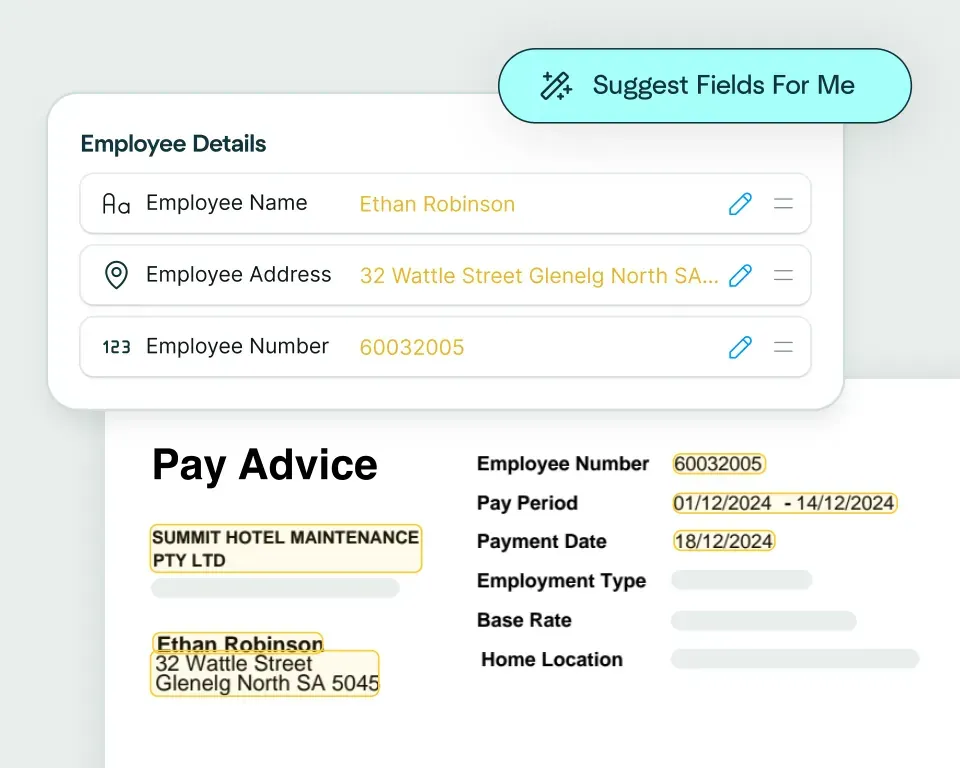
Create models in seconds
Upload a bill of lading and watch as Affinda instantly predicts the data fields you want to extract, helping you automate bill of lading processing in just a few clicks.


















Email, drag and drop or connect via API.
Affinda Extract reads your bills of lading with impressive contextual understanding. It splits and classifies documents, extracts and validates data, then transforms the output to match your business needs.
No manual data entry required. Affinda Extract integrates seamlessly into your existing tech stack.
Upload a bill of lading and watch as Affinda instantly predicts the data fields you want to extract, helping you automate bill of lading processing in just a few clicks.
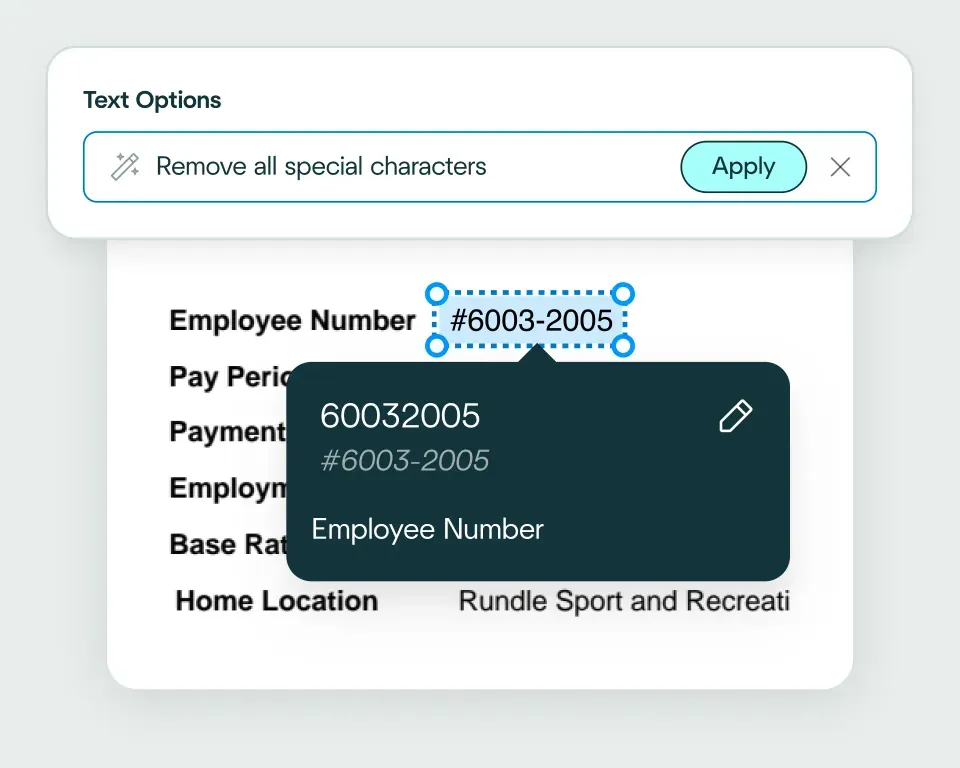
Affinda Extract automatically converts extracted bill of lading data into the format your downstream systems recognise, ensuring it's ready for customs, TMS or ERP integration. Need something custom? Use natural language to describe how you want the data structured.
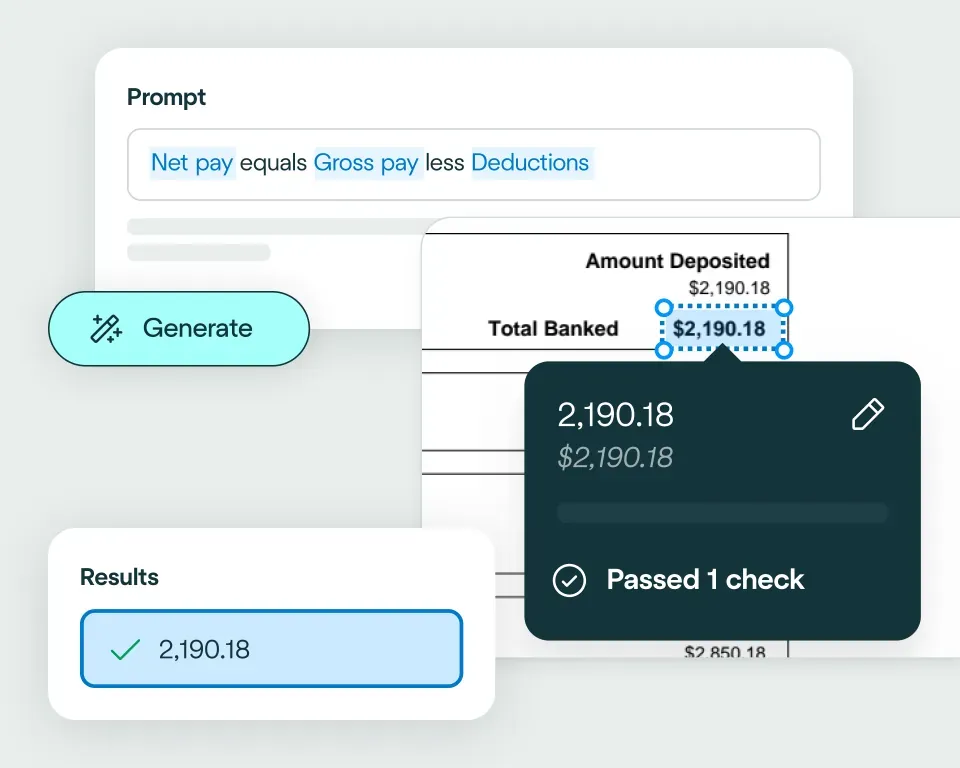
Write validation rules in plain language and apply your business logic to extracted data. This ensures every bill of lading meets your compliance standards and enables straight-through processing.



reduction in manual work
more invoices processed with no added staff
Enhanced auditability and tracking of invoice approvals

proof of delivery documents processed annually
of documents straight-through processed in the first weeks
Automatic validation of documents against ERP system


High accuracy parsing across multiple languages
Improved customer experience thanks to better structured data
Stronger compliance with international data security and software standards


documents processed annually
different document types
time saved in reviewing invoices


reduction in manual data input
reduction in compliance data errors
compliance documents processed annually

Bill of lading processing is the workflow shipping and logistics companies use to capture, extract, validate and track data from bills of lading. Our AI bill of lading processing software automates this entire process to reduce manual data entry, errors and processing delays. It ensures that shipment details, cargo information and reference numbers are accurate and flow seamlessly into your TMS, ERP, customs and supply chain management systems.
Bill of lading data extraction is the process of reading a bill of lading and capturing key data points such as shipper, consignee, vessel, voyage, cargo details, ports, dates and reference numbers. Our platform uses advanced AI to automate bill of lading data extraction, turning unstructured documents into structured data ready for your TMS, ERP, customs platforms and supply chain workflows.
Bill of lading extraction is the automatic capture of shipment and cargo data from bills of lading using AI. Our bill of lading extraction software combines reading order models, OCR, LLMs, RAG and more to extract this information with high accuracy and faster processing times.
A bill of lading parser is a software tool that automatically reads bills of lading and extracts key shipment data into structured, machine-readable formats. Our AI bill of lading parser adapts to different shipping lines, cargo structures and document layouts, learning from every interaction to improve accuracy and handle variations with ease before outputting data in exactly the format your downstream systems require.
Bill of lading line extraction captures cargo and container data from tables within your bills of lading, preserving the relationships between each line item. Our platform handles everything from simple cargo lists to complex nested tables with grouped items, multiple containers and detailed specifications – turning structured table data into formats your systems can use immediately.
Affinda's AI bill of lading processing platform can extract data from any field on a bill of lading. Standard data fields include:
Need custom fields or a specific shipping line format? Simply define them in the UI or describe them in natural language and Affinda will extract and structure them automatically.
Our AI agents can process any file type. Supported file types include PDF, JPG/JPEG, PNG, TIFF, DOC/DOCX (Word), XLSX (Excel), HTML and TXT/CSV.
Affinda's AI agents read, extract and validate bill of lading data. Our platform is intuitive to set up and easily integrates into your systems. Simply:
The result? Faster, more accurate bill of lading processing with minimal manual input.
Yes. Our AI bill of lading processing platform combines OCR with retrieval augmented generation (RAG), LLMs, agentic workflows, proprietary reading order algorithms and more, to automatically detect and process data from scanned or photographed invoices (PDF, JPG, PNG). Even low-quality images are automatically enhanced for reliable data capture and processing.
Our AI bill of lading processing platform can automatically detect and process bills of lading in 50+ languages, including multilingual bills of lading containing more than one language. Supported languages include: Afrikaans, Albanian, Amharic, Arabic (Standard, Egyptian, Sudanese, Algerian, Moroccan, Levantine), Bahasa Indonesian, Bengali, Bhojpuri, Bulgarian, Burmese, Chinese (Mandarin [PRC/Taiwan], Cantonese, Wu, Min Nan, Jinyu, Xiang, Hakka), Croatian, Czech, Danish, Dutch, English, Estonian, Finnish, French, German, Greek, Gujarati, Hebrew, Hindi, Hungarian, Italian, Japanese, Javanese, Kannada, Korean, Latvian, Lingala, Lithuanian, Macedonian, Malayalam, Marathi, Nepali, Norwegian, Odia, Persian (Farsi), Polish, Portuguese, Punjabi (Western and Eastern), Romanian, Russian, Slovak, Slovenian, Somali, Spanish, Swahili, Tagalog, Tamil, Telugu, Thai, Turkish, Ukrainian, Urdu, Vietnamese, Yoruba.
Yes. Our AI bill of lading processing platform integrates with 400+ systems, including major TMS, ERP, customs and supply chain platforms. Build no-code integrations using our AI integrations agent, or connect via API – whatever fits your workflow best.
AI bill of lading processing helps automate and optimize shipping and logistics workflows across business units such as:
A bill of lading optical character recognition (OCR) data extractor scans and accurately captures shipment information from bills of lading, regardless of format or language. Upload bill of lading documents in PDF, JPG or PNG formats. The OCR technology first converts the documents into a text layer, ensuring all text (even from scans, photos or handwriting) is captured. Affinda Extract models then identify and extract key fields such as shipper, consignee, vessel details, voyage numbers, cargo descriptions, container IDs, ports, dates and reference numbers, transforming them into structured, usable data.
This automation eliminates manual data entry, reduces errors and saves time. Once the bill of lading data is captured and structured, our AI bill of lading processing pipeline can apply machine validation and post-processing to enable seamless integration with TMS, ERP, customs and supply chain management systems.
Shipping, logistics and freight forwarding companies rely on Affinda Extract for their shipment tracking, customs clearance and cargo management processes, streamlining workflows and improving overall efficiency.