Should I build or buy an intelligent document processing (IDP) solution?
You already know the benefits of intelligent document processing, but you’re trying to weigh up whether to build your own IDP solution in-house or partner with a specialist provider. This guide will help you decide.
Compare build versus buy across accuracy, cost, speed, integration effort, customization and security.
Should I build or buy an intelligent document processing (IDP) solution?
If you’re reading this, chances are you’re weighing up whether to build your own intelligent document processing (IDP) solution in-house or partner with a specialist provider.
You already know the business case. Manual extraction is tedious, error-prone and slows everything down. In document-heavy industries, there are incredible efficiencies to be gained by reducing the time spent extracting data from lengthy documents. Research suggests that up to 90% of enterprise data is unstructured, translating to countless hours wasted manually extracting data from documents.
Shifting to AI-driven document automation reduces the time spent on document processing, reducing hours of manual work into minutes or zero time at all.
So yes, the benefits of intelligent document processing are clear. But it still leaves the question: should you build or buy your IDP platform?
The two questions that help you decide whether to build or buy your IDP solution
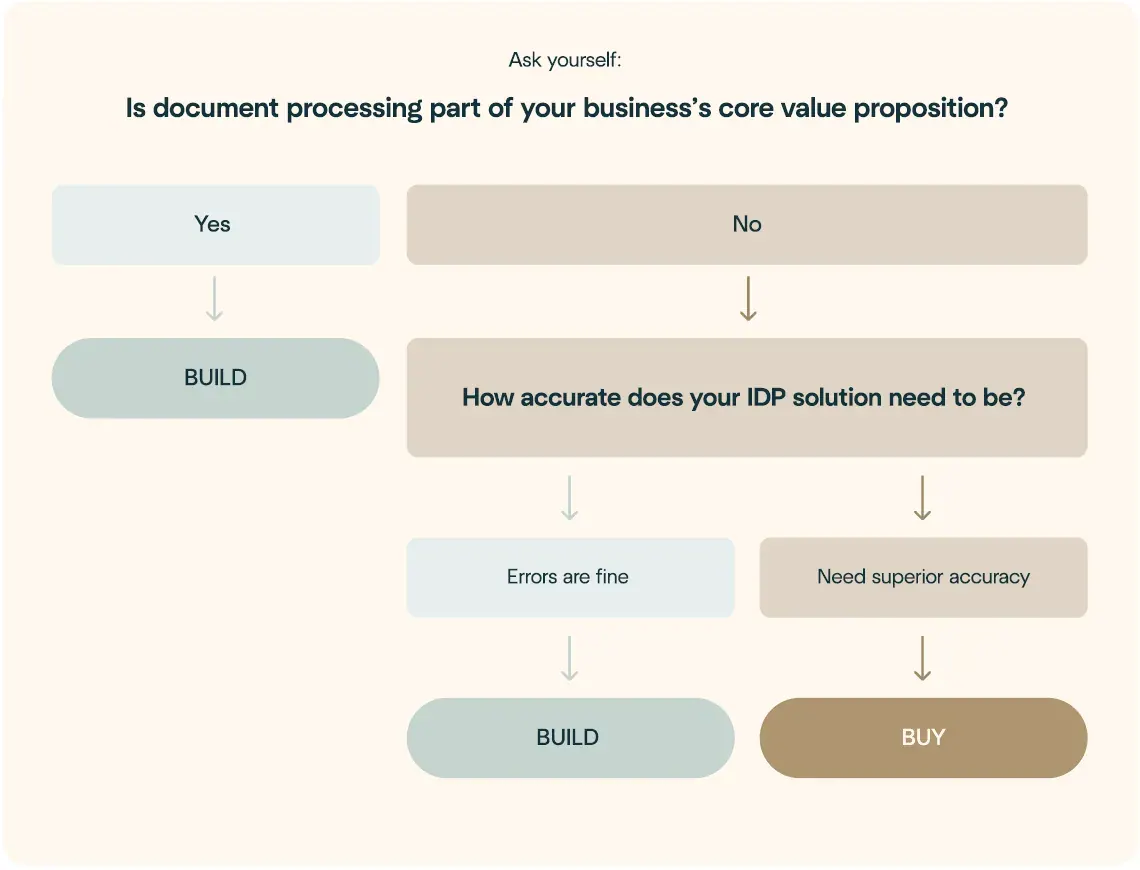
The first question any enterprise should ask itself, according to Affinda’s Head of AI, Andrew Bird, is,
“Is document processing part of your core value proposition?”
“If not, why reinvent the wheel? Unless you’re in the document processing solutions, why waste the time, money and people on developing a solution when purpose-built tools are available instead?”
Affinda’s Head of Growth, Anthony England, agrees. “I haven’t met a mature tech leader who wants to build absolutely everything themselves,” he says. “Increasingly, it’s about connecting microservices to perform a task, so their team doesn’t have to do it – intelligent document processing isn’t a core priority.”
The second – often overlooked – question is,
“How accurate do you need your IDP solution to be?”
If you’re working with a low-risk use case and can tolerate some errors, you might be able to build something functional using a Large Language Model (LLM). As long as you consider and mitigate any risks relating to privacy, compliance and operational resilience, there’s no issue. But in high-stakes sectors, such as Banking & Financial Services,Insurance and Healthcare, near-perfect accuracy is business-critical. This is where external intelligent document processing solution providers, like Affinda, are the right choice.
What else you need to consider when deciding between build vs buy
Even if document processing is a core value proposition of your business and you have the human capacity to deal with a reasonable volume of errors, you should still consider a number of other factors before committing to deciding to build.
How much customization do you need? If your workflows are highly unique, you’ll need significant in-house development expertise and responsiveness – both of which come with a hefty price tag. You’ll have the freedom to tailor everything from the ground up, but this is a feature that the best IDP solution providers offer and excel at too.
How much control do you need? If you have a skilled tech team and time to spare, building your own solution gives you full control over the development process, letting you innovate and iterate based on feedback. However, as with high customization needs, this will require intensive time ongoing and will tie up those senior resources more than you’d expect.
How much document variability support do you need? Building your own IDP solution that can handle any document type in any format at a consistently high accuracy will require the latest agentic AIexperience to implement. These resources will also need to keep on top of every innovation as it hits. Buying an IDP solution that handles document variabilityand guarantees high accuracy means you can outsource this burden to them, while feeling confident your chosen IDP platform will always perform.
How quickly do you need it to go live? The best IDP solution providers will support you to test, iterate and go live in moments. Whereas, building your own IDP solution from the ground up can take months. Look for IDP solutions that allow you to trial for free, like Affinda, so you can test the platform out risk free.
How much budget do you have? If you’re short on time, funds or resources, buying an IDP solution is definitely the most economic path, especially once you factor in ongoing maintenance and compliance. There are even IDP platforms available to buy that offer flexible pricing, designed to scale with your document processing needs, so you only need to pay for what you use.
The case for building your own intelligent document processing solution
The two primary benefits of building your own in-house intelligent document processing platform are product growth and control. IDP, as a process, is a beneficial addition to many SaaS platforms, such as:
Plus, building your own IDP platform gives you complete control over the end-to-end process. You decide on the technologies, data management practices and security measures, giving you the flexibility to adapt as your business evolves.
What to look out for when building your own
Choosing to build your own intelligent document processing (IDP) solution means navigating two distinct categories of challenge: development hurdles and – once it’s live – performance limitations.
Development challenges with an in-house IDP solution
Building your own intelligent document processing solution from scratch may seem achievable, but it often comes with unexpected complexity.
The most common challenges that arise are:
Starting but then having to stop because you’ve underestimated the scale of tech stack and resourcing required.
Go live date pushing further and further back because of longer than expected development timelines and skilled personnel shortages.
Significant downstream challenges after launching too early due to leadership team pressure.
Start/Stop: Underestimating the tech stack and resourcing required
Organizations often underestimate the challenge involved in navigating the complex technology stack and resource set required when building your own IDP solution. The tech and resourcing stack includes, at a minimum:
An external, or self-hosted, large language model.
Selectively applied OCR tools, such as Google Cloud Vision or Tesseract OCR.
Backend frameworks, like Django or Flask, and frontend frameworks, like React.
Data annotation tools and user feedback mechanisms.
Teams of data scientists, software engineers, domain experts and project managers.
Go live-date pushing: Development timelines blowing out
You don’t need us to remind you that tech teams are already under pressure. Creating accurate intelligent document processing software in-house is a time intensive, long-haul project.
“It may be a five-minute exercise to build something very simple that kind of works but moving past the experiment stage to create something enterprise-ready has a long tail,” warnsAndrew Bird, Affinda’s Head of AI. “The risk for businesses is they see a sign of early success but then need to spend years bug-squashing when they could have skipped all that. If they aim to build a solution equivalent to Affinda’s, we’re talking several years for a team of at least three or four people.”
Downstream challenges: Launching too fast and under pressure
We get it. Pressure is mounting from your leadership team, who expect AI integration to show tangible ROI in efficiency and productivity gains from day one. Waiting years for a bespoke solution to take shape usually isn’t part of the plan. So, you launch as soon as you can only to find the gains at the document processing stage are offset by efficiency and productivity losses further downstream as errors and inconsistencies impact.
Performance challenges with an in-house IDP solution
Even if you overcome the development hurdles, you’re not out of the woods yet. Once the system is built, maintaining high performance across diverse intelligent document processing use cases becomes an entirely different challenge.
Your solution struggles with document variety so you get stuck on only one use case working well.
You’re stuck below the accuracy threshold
The last mile is always the hardest. Getting to 95% accuracy from your custom-built solution might feel like a win – until you realize it’s not enough for mission-critical document processing. It’s at this point that many enterprises reach out to IDP solution providers, like Affinda, for assistance.
“It depends on the scenario,” says Affinda’s Head of Growth, Anthony England. “If it’s a simple use case, you may get 99% accuracy. But if it’s complicated, you may only reach 70%.”
Bird adds, “LLMs are seductive. They make 95% feel like an easy win. But when you drill down to the last-mile challenges, you’ll discover a lot of idiosyncrasies, literally hundreds of annoying challenges that make it hard to get from 95% to something that’s ready for enterprise,” he says.
Your model doesn’t improve over time
Many DIY document processing solutions rely on static prompt chains that are brittle, hard to update and prone to regression. One tweak might solve one problem but cause three more.
In practice, this means that an intelligent document processing solution built as an in-house project quickly becomes outdated unless it’s under constant active development, leaving you sitting on legacy code. One way to overcome this and achieve both continuous improvement and world-class accuracy is to employ model memory with real-time learning, using a retrieval-augmented generation (RAG) system.
“But setting up that RAG architecture is an enormous piece of work,” says England. “It makes more sense to buy intelligent document processing from an external provider who’s spent a decade or more on this problem.”
Your solution struggles with document variety
Variability in document types, formats and structures is the biggest hurdle for document processing solutions to overcome.
Template IDP solutions (the easiest to build) rely on manually created rules, anchors and regex. They work brilliantly when document layouts are stable but are fragile and high maintenance when those layouts drift and change.
Machine learning IDP solutions use transformer-based models that are fine-tuned per document type. They need fewer rules and can handle wider document variations, but they require considerable operational overhead to manage them ongoing.
Agentic IDP solutions, on the other hand, use LLMs to generate structured outputs directly (e.g. JSON), supported by agents that validate against the source document and business rules. They deliver faster iteration, wider coverage and higher accuracy. However, they’re also the most complex to build and get right.
The case for buying an IDP solution
Buying an intelligent document processing solution gives you immediate access to mature, enterprise-grade capability without the cost, delay or uncertainty of building your own platform. Instead of investing months into data labelling, model training, integration work and ongoing maintenance, a proven IDP provider delivers instant accuracy, fast deployment and measurable ROI from day one.
Buying an IDP solution also unlocks benefits that are difficult to achieve internally, such as:
Faster time-to-value
Continuously improving accuracy
Lower total cost of ownership
Dramatically reduced implementation risk
Modern IDP platforms, especially those built on agentic AI, come pre-packaged with the almost every capability you could need, such as:
High-accuracy extraction
Real-time, iterative learning
Scalable infrastructure
Enterprise security
Seamless integrations
Flexible configuration options
One of the most persuasive cases for buying an IDP solution, especially one with an intuitive UI, is the increase in job satisfaction (and corresponding decrease in staff turnover) that your organization will enjoy.
The best IDP solution providers will support you to be up and running fast, delivering a reduction in low-value, repetitive document and data entry tasks. Your teams will be able to turn their attention to the high-value work that they enjoy and that actually moves the business forward. High-value tasks like making decisions, serving customers faster, resolving exceptions, managing risks and improving operations.
Your teams can stay productive and engaged, while the heavy lifting of document data extraction, validation, cross-checking and integration happens automatically in the background.
What to look for when buying an IDP solution
Buying an IDP solution doesn’t reduce your control; it strengthens it. You gain a configurable, continuously improving platform that handles the complexity for you, without the operational burden of building and maintaining the entire pipeline yourself.
These are the key features and benefits you should be looking for when weighing up different IDP solutions to buy.
Faster time-to-value
Speed matters, and a proven IDP solution starts delivering significant time and cost savings almost immediately. This means you can start seeing measurable benefits straight away. Look for an IDP provider that allows you to trial the solution for free before you commit.
Affinda provides a turnkey AI-driven document automation solution that meets enterprise needs without requiring extensive internal development. Build fast, win fast and trial free for 14 days to see that fast time-to-value in action.
Higher accuracy and continuous learning
Intelligent document processing solutions shouldn’t just perform well initially but also improve over time through instant learning and updates. It’s essential to have measurable metrics to track accuracy and performance.
Affinda is among the first intelligent document processing platforms designed around a genuinely agentic workflow. Our models retain contextual memory, continuously learning from every document and user instruction to refine themselves in real time.
Combined with more than a decade of proprietary research, this intelligence pushes accuracy beyond 99%, ensuring world-class performance in artificial intelligence document processing.
Lower total cost
Tech budgets are usually approved annually, making it difficult to commit to solutions midway through the year or with high upfront costs. Look for transparent, flexible and scalable pricing models from the IDP platforms you’re choosing between. Affinda Extract's pricing is flexible – consumption-based, value-based or a mix – and our onboarding is fast, which means a quicker path to ROI. You should also look to do a free trial of any IDP platforms before you commit so you can minimize the financial risk.
IDP platform also means you bypass the most expensive elements of developing your own solution, like hiring extra people to maintain the system and extensive, ongoing bug-squashing.
Reduced implementation risk
With the right provider, buying an IDP solution is a much less risky prospect than building your own platform. Speak to potential IDP providers, like Affinda, to ensure they’ll support you with everything you need, such as:
With a vendor handling the system, you don’t have to worry about maintaining it or ensuring data security. This reduces your reliance on internal resources and gives you one less thing to worry about. Plus, the best IDP platform providers keep their platforms updated, so you benefit from improvements and avoid the risk of legacy code down the track.
Fewer manual errors
Accuracy has a compounding effect. Thebest IDP solutions achieve more than 99% accuracy. This reduces back-and-forth corrections and human errors, meaning your teams can enjoy fewer delays and rework, and the leadership team can enjoy higher staff retention.
Lower reputational risk
The development and implementation journey for an in-house IDP solution is riddled with risks and pitfalls, from choosing the wrong approach to cost and time blowouts. And all of it reflects on the people who championed the project.
Reduce your risk by choosing a proven IDP platform provider, with strong reviews and case studies. With their help on your side, you’ll nail the implementation – and look great at your job in the process.
Simplified system integration
Evaluate potential IDP solution providers based on their ability to integrate with the three main points of integration that impact the typical document journey: ingestion, validation and document export.
Custom systems often require extensive development to integrate with existing enterprise systems at these three points, but the best IDP solutions, like Affinda, come with pre-made connectors for popular integrations, meaning you can connect multiple systems with ease for straight-through processing.
Customization and platform control
Buying an IDP platform doesn't mean you need to give up control. The top intelligent document processing software should give your teams the flexibility to customize, configure and adapt the platform to your needs, while also being on hand to support as needed. This flexibility ensures that you can configure the platform to meet your unique use case, so it can evolve with the business and remain best-in-class. Affinda is designed to be developer-friendly, offering deep customization options that enable technical teams to tailor existing and future workflows.
Effortless scalability
As your organization grows, so do your document and data needs. Leading intelligent document processing solutions can handle high-volume workloads and adapt to increasing data requirements without compromising performance. Look for providers that offer scalability within the platform as well as within their pricing.
Enterprise-grade security and compliance
Security is a common concern in document control – and rightly so. By choosing a leading IDP platform provider, you can bypass complex compliance-related hurdles, easing your security burden, not adding to it.
At Affinda, we spend all day thinking about security, so you don’t have to. We’re ISO 27001:2022 certified and SOC 2 and GDPR compliant. We have global data centers and adhere to international privacy principles. We also work with a range of sensitive industries and can offer deployment flexibility to meet your data and compliance requirements – whether hosted or self-hosted, local or global.
Should I build or buy an IDP solution? The definitive comparison table
Lengthy process to design, build, test and integrate, then potentially several years of bug-squashing.
A turnkey solution ready to meet enterprise needs without extensive internal development.
Budget
High development costs with the risk of blowouts. Ongoing costs for continuous improvement.
Consumption-based pricing, low setup costs and the vendor takes care of continuous improvement.
Ease of integration
May require extensive development for integration with existing enterprise systems.
May require some plugging in and data customization. Leading IDP providers support your team every step of the way.
Independence and customization
Highly customizable, built for specific enterprise needs.
Leading IDP systems allow for customization, modification and full control by your engineers.
Data security and regulatory compliance
Customized to your organization’s current security needs and will require updating as regulations change.
Verified security protocols that meet your specific security needs, such as ISO 27001:2022 certified and SOC 2 and GDPR compliant.
Ready to buy the perfect IDP solution for your organization?
We hope our deep dive into whether to build or buy an IDP platform has helped you make your decision. As we’ve seen, the best way to decide which IDP solution is best for your document processing need firsthand. Affinda’s free trial gives you full access to our IDP solution – so you can see the speed, accuracy and ease of integration for yourself.